Chicago, IL real estate
Homes for sale, the monthly market report, selling, and the neighborhoods, all on one page for Chicago. Median value $425K, 47 days on market.
Chicago, IL holds about 1,277,054 homes, 46% of them owner-occupied, with a median year built of 1954. Chicago offers urban multi-unit properties, condominiums, and single-family detached homes. Purchasers evaluate urban density and property tax rates against the expansive yards found in western suburbs. Pricing spans diverse thresholds across distinct city neighborhoods.
Chicago is read the same way as every other town here: comparable sales first, then the house.
Source: Redfin (through May 2026) · U.S. Census ACS (2024)

Chicago on record
- Population
- 2,711,226
- Households
- 1,160,205
- Median household income
- $77,902
- Median home value
- $334,100
- Median rent
- $1,440
- Owner-occupied
- 46%
- Median year built
- 1953
- Average commute
- 33 min
- County
- Cook County
- Land area
- 227.7 sq mi
Source: U.S. Census Bureau ACS 5-year, 2020–2024 5-year estimate; U.S. Census Bureau TIGER, Vintage 2024. Retrieved September 2026.
Neighborhoods in Chicago
Lincoln Park
Boundaries include Diversey Parkway to the north, North Avenue to the south, Lake Michigan to the east, and the Chicago River to the west.
The Loop
Chicago central business district is bounded by the Chicago River to the north and west, Lake Michigan to the east, and Roosevelt Road to the south.
Hyde Park
Located on the South Side along Lake Michigan, this area is bounded roughly by 51st Street, 60th Street, and Washington Park.
Logan Square
Located on the Northwest Side, this area is centered on wide boulevards designed by William Le Baron Jenney.
Lakeview
Bounded by Diversey Parkway to the south, Irving Park Road to the north, Lake Michigan to the east, and Ravenswood Avenue to the west.
Wicker Park
Situated northwest of downtown, this neighborhood is bounded by Western Avenue, the Bloomingdale Trail, Ashland Avenue, and Division Street.
Also in Chicago: Albany Park, Andersonville, Andrews and Hurds Subdivision, Arcade Row, Archer Heights, Arizona, Armour Square, Ashburn, Auburn Gresham, Auburn Park, Austin, Avalon Highlands, Avalon Park, Avalon Trails, Avondale, Back of the Yards, Becks Park, Belmont Cragin, Belmont Gardens, Belmont Park, Beverly, Bowmanville, Brainerd, Bricktown, Brighton Park, Bronzeville, Brookdale, Bryn Mawr East, Bryn Mawr West, Essex, Forest Glen, Fulton Market District, Jackson Park Highlands District, Lakewood Balmoral Historic District, Marynook, O'Keeffe, Parkside, Peterson Park (39th Ward), The Island and Trumbull Park Homes. These have no page of their own yet; ask about any of them.
The Chicago market right now
The Chicago median sold price stands at $425,000 as of May 2026, +6% year over year. The twelve-month peak was $425,000 in April 2026. 24,715 homes closed over the period, averaging 101.8% of list price most recently, with 47 days on market.
Chicago neighborhoods side by side
| Neighborhood | Housing stock |
|---|---|
| Lincoln Park | Housing consists of late nineteenth-century brick and greystone row houses, two-flats, and converted condominiums alongside mid-century high-rises along the lake. Standard residential lots measure 25 by 125 feet on a grid street layout, often with detached garages accessed via rear alleys. |
| The Loop | The housing inventory is comprised of high-rise condominium buildings and converted historic office towers dating from the late nineteenth century to recent construction. Residences range from studios to multistory units within a dense urban grid, with parking typically located in integrated interior parking decks. |
| Hyde Park | Housing includes pre-war courtyard apartment buildings, Victorian single-family homes, brick row houses, and mid-century high-rises. Structures sit along a rectangular street grid, with residential lots varying from standard urban parcels to larger corner plots. |
| Logan Square | The built environment features late nineteenth- and early twentieth-century greystones, brick two-flats, three-flats, and frame bungalows arranged along wide boulevards and standard grid lots. Most residential parcels measure 25 by 125 feet and include rear detached garages served by public alleys. |
| Lakeview | Residential stock includes late nineteenth-century frame houses, brick three-flats, and courtyard buildings, as well as high-rise condominiums closer to the lakefront. Buildings are constructed on standard 25-by-125-foot grid lots with alley-accessed parking and modern infill construction. |
| Wicker Park | The neighborhood consists of Victorian-era brick mansions, nineteenth-century cottages, two-flats, and modern infill condominium buildings. Streets follow an urban grid with standard 25-foot-wide lots, detached rear garages, and occasional carriage houses along alleys. |
School districts in Chicago
From public records, with the source for each. District boundaries do not follow city lines; check the address with the district.
Chicago Public School District 299
Grades PK–12 · Unified district · NCES EDGE school district boundaries 2024-2025, September 2026
Alsip-Hazelgreen-Oaklawn School District 126
Grades PK–8 · Elementary district · NCES EDGE school district boundaries 2024-2025, September 2026
Argo Community High School District 217
Grades 9–12 · High school district · NCES EDGE school district boundaries 2024-2025, September 2026
Atwood Heights School District 125
Grades PK–8 · Elementary district · NCES EDGE school district boundaries 2024-2025, September 2026
Bensenville School District 2
Grades PK–8 · Elementary district · NCES EDGE school district boundaries 2024-2025, September 2026
Burbank School District 111
Grades PK–8 · Elementary district · NCES EDGE school district boundaries 2024-2025, September 2026
Burnham School District 154-5
Grades KG–8 · Elementary district · NCES EDGE school district boundaries 2024-2025, September 2026
Calumet Public School District 132
Grades PK–8 · Elementary district · NCES EDGE school district boundaries 2024-2025, September 2026
Districts are listed by name and source only, never by rating: choosing a home by school quality is yours to weigh, and fair-housing law keeps an agent out of steering it.
Living in Chicago
About Chicago
Chicago is located in Cook County and has a population of 2,711,226 across 48 neighborhoods. The cityscape includes recognized landmarks, such as Willis Tower and The Wrigley Building. Central commercial centers sit immediately adjacent, with The Loop located 0.3 miles away, which is a two-minute drive. For air travel, Midway International Airport is an 11.2-mile trip that takes 26 minutes by car. In addition, commuters traveling west to Oak Brook have a 20-mile drive that takes 45 minutes.
Chicago suits buyers who prioritize properties with direct access to dense employment hubs and regional roadways. Housing stock across the 48 neighborhoods offers practical proximity to commercial districts, transit routes, and suburban employment centers. You can examine specific local prices, inventory figures, and recent sales trends in the market section below.
Is Chicago a good place to live?
Chicago encompasses 227.7 square miles of land area within Cook County. The city is home to 2,711,226 residents living in 1,160,205 households. If you look at the established housing stock, the median year built is 1953. Commuting to work is a regular part of local life, with a commute time of 33 minutes. This commute data gives you a practical sense of typical travel times across the area.
Understanding local housing costs and financial benchmarks helps you evaluate your real estate decisions. The median household income for the area is $77,902. Homeownership represents a significant segment of the market, with owner-occupied homes making up 46.0 percent of occupied units. When you explore purchasing an existing property, you will find a median home value of $334,100. For residents who prefer to lease, the median rent is $1,440 per month. Examining these figures together gives you an objective overview of property values, rental rates, and household earnings. You can use these facts to guide your planning before you view available homes in the city.
Chicago at a glance
Chicago covers 227.7 square miles within Cook County, where it contains 1,160,205 households and a total population of 2,711,226. You can review the reference table below for baseline community measurements, including local household income, home values, rent, and typical commute times.
Homes and neighborhoods in Chicago
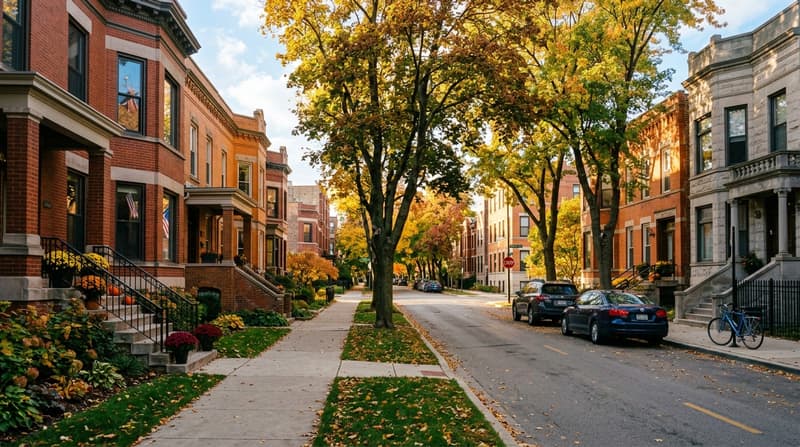
In Lincoln Park, you will find late nineteenth-century brick and greystone row houses, two-flats, and converted condominiums alongside mid-century lake high-rises. Most parcels follow a grid layout measuring 25 by 125 feet, with detached garages positioned on rear alleys. Lakeview features a similar street footprint with nineteenth-century frame homes, brick three-flats, courtyard buildings, and lakefront high-rise condominiums. In The Loop, housing shifts to high-rise condominiums and converted historic office towers dating from the late nineteenth century to recent construction. Residences there span from studios to multistory units set above interior parking decks.
Logan Square displays late nineteenth- and early twentieth-century greystones, brick two-flats, three-flats, and frame bungalows along wide boulevards. These properties occupy standard 25-by-125-foot lots with rear detached garages accessed by public alleys. In Wicker Park, you will find Victorian-era brick mansions, nineteenth-century cottages, two-flats, and modern infill condominiums. Streets there feature 25-foot-wide lots with detached rear garages and occasional alley carriage houses. Further south in Hyde Park, the housing inventory provides Victorian single-family residences, pre-war courtyard buildings, brick row houses, and mid-century high-rises. Lots in Hyde Park range from standard urban parcels to larger corner plots across a rectangular street grid.
Across Chicago, residential structures built before 1940 represent 38.8 percent of the housing stock. Buildings constructed from 1940 through 1969 make up 28.7 percent, while structures from 1970 through 1999 account for 17.6 percent. Properties built from 2000 through 2009 total 8.6 percent, and homes built in 2010 or later represent 6.3 percent.
The Chicago housing market
The Chicago housing market shows steady activity across the twelve-month tracking period ending in August 2026. In August 2026, the median sold price reached $483,000, compared to $469,000 in September 2025. Homes sold during August 2026 spent an average of 17 days on the market before going under contract. That marketing time decreased from an average of 20 days recorded in September 2025.
Inventory and transaction volumes remained closely matched over the course of the year. Sellers brought 20 new listings to the market in August 2026, while buyers closed on 13 homes. In September 2025, the market recorded 21 new listings and 12 closed sales. Properties closed at an average of 97.9 percent of their listing price in August 2026, compared to 99.0 percent in September 2025. You can review the full market report for detailed historical figures and ongoing updates.
Housing stock
As you explore residential options across Chicago, you will find that multi-unit properties make up 70.5% of the overall supply. Single-family detached houses account for 25.6%, single-family attached homes represent 3.5%, and manufactured or other structures make up 0.3%.
Older construction defines much of the city, with 38.8% of all residences built before 1940. Buildings completed between 1940 and 1969 constitute 28.7% of the total, and those constructed from 1970 through 1999 account for 17.6%. You will see smaller shares of recent construction, as 8.6% of homes date to between 2000 and 2009, and 6.3% were built in 2010 or later.
Schools serving Chicago
Chicago Public School District 299 serves students from prekindergarten through twelfth grade. Elementary options in the region include Alsip-Hazelgreen-Oaklawn School District 126, Atwood Heights School District 125, and Bensenville School District 2. Students are also served by Burbank School District 111, Burnham School District 154-5, and Calumet Public School District 132. Argo Community High School District 217 provides education for grades 9 through 12.
For higher education, you will find The University of Chicago and University of Illinois Chicago.
Getting around
Daily commutes from the area offer several driving and transit routes to major destinations. You can reach The Loop quickly, with a 0.3-mile drive taking two minutes or a one-mile transit trip taking 13 minutes. Driving to Midway International Airport takes 26 minutes over 11.2 miles, while transit makes the 11.3-mile journey in 67 minutes.
A trip to Oak Brook takes 45 minutes by car over 20 miles, while transit takes 117 minutes across 21.2 miles. For rail travel, you have access to the CTA Red Line and Chicago Union Station.
Things to do in Chicago
You can spend time outdoors across Chicago at municipal parks, waterfront paths, and designated trails. Millennium Park provides green spaces and walking paths near the downtown core. For walking, running, and cycling, you can access the Lakefront Trail along Lake Michigan or travel along The 606. Along the water, you will find North Avenue Beach and the Chicago Riverwalk. For golf, you can play rounds at the Sydney R. Marovitz Golf Course or the Jackson Park Golf Course.
For dining outings, you can spend time in the Fulton Market District, which is widely known for its restaurants. When you plan a shopping trip, you can visit Water Tower Place. This multi-level shopping destination provides indoor access to numerous retail stores and commercial shops.
The city also contains prominent civic facilities and event spaces. You can attend concerts and athletic games at the United Center. For research, reading, and educational resources, the Chicago Public Library serves the community through neighborhood branches and its main anchor, the Harold Washington Library Center.
Working in Chicago
Northwestern Memorial Hospital serves as a major employer in Chicago. This hospital operates as part of an expansive health system that supports local jobs. If you work in healthcare, the hospital represents one of the primary institutions in the city. Northwestern Memorial Hospital anchors a significant portion of medical employment through its health system network. You can find opportunities across different departments within the hospital and its broader health system.
Pros and cons of living in Chicago
Living in Chicago offers advantages in central travel and housing transaction speed. In August 2026, homes spent an average of 17 days on the market, and 20 new listings arrived. You can reach The Loop in a 2-minute drive of 0.3 miles, while Midway International Airport is an 11.2-mile drive taking 26 minutes. In addition, the median home value is $334,100, and the median rent is $1,440.
Several points present trade-offs for prospective buyers to consider. The overall average commute time is 33 minutes, and driving 20 miles to Oak Brook takes 45 minutes. The median year built for homes is 1953, reflecting an established housing stock. In August 2026, the median sold price reached $483,000, and buyers paid 97.9% of the asking price across 13 closed sales.
Sources: U.S. Census Bureau ACS 5-year; U.S. Census Bureau TIGER.
Tell me what you're trying to do
Buying, selling, or still deciding, a short note is enough to start. You'll get a real reply from me, not an auto-responder.
- A person reads every message
- No drip campaign, no lead-sharing with other agents
- Happy to answer one question and leave it there
Talk to someone who works Chicago
I have 2 years in these neighborhoods and answer personally.